
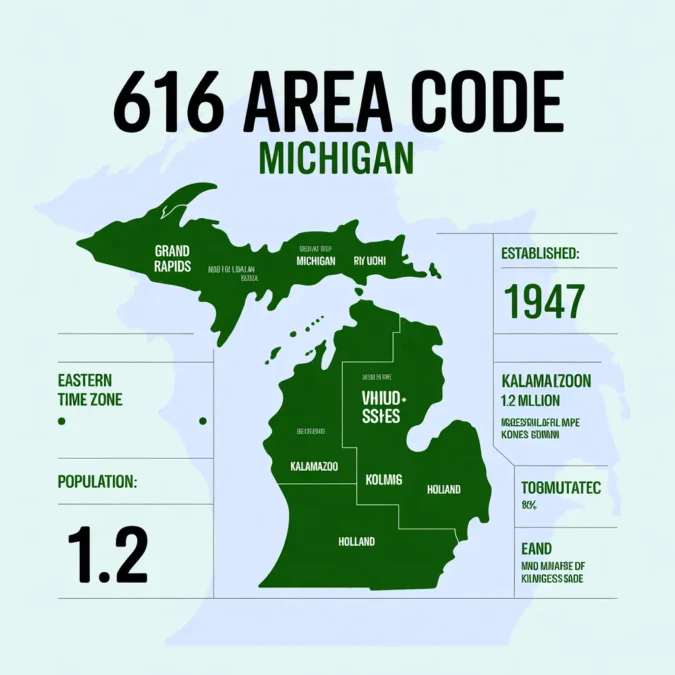

The 616 area code is one of the most well-known telephone area codes in the United States, primarily serving the western region of the state of Michigan. It is most closely associated with the city of Grand Rapids, which is the largest city within this area code and serves as a major economic, cultural, and technological hub in the region. Over the years, the 616 area code has become an important identifier for residents and businesses, symbolizing a strong connection to West Michigan’s identity and growth.
The 616 area code was established in 1947 as one of the original area codes created under the North American Numbering Plan. At that time, it covered a much larger portion of Michigan. However, due to population growth and increasing demand for telephone numbers, the area code has undergone several splits and adjustments. Despite these changes, 616 has remained strongly associated with Grand Rapids and surrounding communities, maintaining its cultural and historical importance in the region.
📍 Where Is the 616 Area Code Located?
The 616 area code is located in western Michigan and primarily serves Grand Rapids and its surrounding areas, including cities such as Wyoming, Kentwood, Holland (partially), and Grand Haven. This region is known for its strong industrial base, growing technology sector, and vibrant cultural scene. Grand Rapids, in particular, is often referred to as the heart of the 616 area code due to its size and influence.
Because of its central role in West Michigan, the 616 area code is widely recognized by both residents and businesses. Many companies use 616 numbers to establish a local presence and build trust with customers in the region. Even as new overlay area codes have been introduced in Michigan, 616 continues to hold a strong identity and is often viewed as a prestigious local code.
🕰️ Time Zone of the 616 Area Code
The 616 area code operates in the Eastern Time Zone (ET), which is used by much of the eastern United States. This means it follows Eastern Standard Time (EST) during the fall and winter months and Eastern Daylight Time (EDT) during daylight saving time in the spring and summer. The time zone is important for business operations, communication, and scheduling, especially for companies that interact with clients across different regions of the country.
Understanding the time zone is essential for avoiding missed calls or scheduling conflicts, particularly for businesses operating across multiple states or internationally. Since Grand Rapids is a growing business hub, many organizations rely on accurate time coordination within the 616 area code region.
📜 History and Evolution of the 616 Area Code
The 616 area code was one of the original codes introduced in 1947 and originally covered the entire western half of Michigan’s Lower Peninsula. As the population increased and demand for phone numbers grew, the area code was gradually reduced in size through splits. One of the most significant changes occurred when northern and southwestern portions of the original 616 region were assigned new area codes, such as 231 and 269.
Despite these changes, 616 remained centered around Grand Rapids, which continued to grow as a major metropolitan area. The introduction of modern communication technologies, including mobile phones and internet-based calling, further increased demand for new numbers. However, instead of replacing 616, additional overlay codes were introduced in Michigan to support the growing need while preserving the original 616 identity.
📞 Dialing and Communication Rules
To dial a number within the 616 area code, callers must use the full 10-digit format, including the area code itself. This is required due to modern telecommunications standards and the presence of multiple area codes in the same region. For international calls, the United States country code (+1) must be added before the area code and local number.
Businesses and residents alike use 616 numbers for both personal and professional communication. Having a 616 number is often seen as a sign of local credibility in West Michigan, especially for companies that want to build trust with regional customers.
⚠️ 616 Area Code and Scam Awareness
Like many area codes, 616 numbers can sometimes be used in phone spoofing or scam attempts. Scammers may manipulate caller ID systems to display a 616 number in order to appear local and trustworthy. It is important for individuals to remain cautious when receiving unexpected calls, especially if the caller requests personal or financial information.
However, it is important to note that the area code itself is completely legitimate and widely used throughout Michigan. Most calls from 616 are genuine business, personal, or service-related communications from within the Grand Rapids region.
Conclusion
The 616 area code is a historic and highly recognized telephone code that represents the heart of West Michigan, especially the Grand Rapids region. From its establishment in 1947 to its modern-day role in supporting a growing metropolitan area, 616 continues to serve as an important communication identifier for residents and businesses alike. Its connection to economic growth, cultural development, and regional identity makes it one of the most significant area codes in Michigan. Whether used for personal communication or business branding, the 616 area code remains a strong symbol of local presence and trust.
FAQ Section
1. What city uses the 616 area code?
The 616 area code primarily serves Grand Rapids, Michigan, along with surrounding cities in western Michigan.
2. What state is the 616 area code in?
It is located in the state of Michigan in the United States.
3. Is the 616 area code still active?
Yes, the 616 area code is still active and widely used in West Michigan.
4. What time zone is the 616 area code?
It is in the Eastern Time Zone (ET).
5. Can 616 area code calls be scams?
Yes, scammers can spoof any area code, including 616, so caution is recommended with unknown callers.